Traveling with medications requires attention to labels, storage terms, and practical handling. Key terms such as active ingredient, lot number, expiration date, and dosage strength guide safe use, while guidance on temperature—cool, dry, stable environments—directs correct storage. On the go, pills, liquids, and injectables demand different contingencies, including portable containers and possible refrigeration. The challenge lies in maintaining potency during transit and avoiding mix-ups, leaving the reader with questions about how to apply these principles in real scenarios.
What Is the Lay of the Land: Basic Terms You’Ll See on Medication Labels
Medication labels pack essential information into concise terms that readers will encounter repeatedly. The lay of the land includes label literacy concepts such as active ingredient, lot number, expiration date, storage guidance, and dosage details. Dosing terms specify strength, unit, and frequency, clarifying administration. The reader gains practical, actionable understanding without ambiguity, supporting informed choices and safer travel-related medication practices.
How Temperature Affects Meds and What “Cool, Dry Place” Really Means
Temperature can alter the stability and potency of many medications, making storage conditions a key factor in travel safety. Temperature affects active ingredients, degradation rates, and shelf life; variation can reduce efficacy. Clinically, cool, dry storage is advised. The discussion emphasizes identifying ambient temperature ranges and implementing tips for moisture control to prevent spoilage and maintain potency during transit.
Managing Storage on the Go: Travel Scenarios for Pills, Liquids, and Injectables
Travel scenarios demand concrete strategies for preserving the integrity of pills, liquids, and injectables under varying environmental conditions. This section outlines practical, non-technical guidance for on‑the‑go storage, emphasizing dependable handling of travel pills and liquid storage during transit. It addresses containers, labeling, and timing, while avoiding assumptions about refrigeration, enabling informed decisions for safe, portable medication management.
Refrigeration and Power: Keeping Medicines Safe in Transit and While Sightseeing
Refrigeration and power considerations become particularly relevant when moving from general on‑the‑go storage to preserving the potency of temperature‑sensitive medicines during travel and sightseeing.
The discussion applies refrigeration basics to portable contexts and highlights power considerations for coolers, insulated containers, and backup options, ensuring stable temperatures, uninterrupted access, and safe transport without compromising therapeutic efficacy or user autonomy.
Practical Checklists to Pack, Monitor, and Avoid Mix-Ups Before You Leave
Practical checklists provide a structured approach to packing, monitoring, and preventing medication mix-ups before departure.
A standardized travel checklist guides separation of similarly named drugs, dosing aids, and documentation.
Investors in safety minimize labeling mistakes by verifying names, strengths, and expiration dates.
Systems encourage consistent container labeling, clear compartmentalization, and companion notes, reducing risk for travelers seeking freedom with predictable routines.
Frequently Asked Questions
How Should I Track Expiration Dates While Traveling?
Expiration tracking while traveling requires a concise system: log dates, monitor pill counts, and verify with pharmacy labels. Packing medication inventory while abroad, maintain an updated list and backups. A clinician-like, precise approach supports freedom with safety.
Can I Transport Marijuana-Derived Meds Across Borders?
Marijuana-derived meds cannot legally cross borders in most jurisdictions; border crossing concerns escalate penalties. Marijuana legality varies, so travelers should consult authorities, adhere to regulations, and consider alternatives. The policy emphasizes caution and legal compliance, not risk-taking.
What About Storing Meds in Hotel Minibars?
Hotel minibar storage is not advisable for medications, as hotel environment safety can be compromised by temperature fluctuations and contamination; proper storage strategies should be used, ensuring accessibility while maintaining safety and personal freedom.
Do Pill Organizers Affect Pill Safety During Flights?
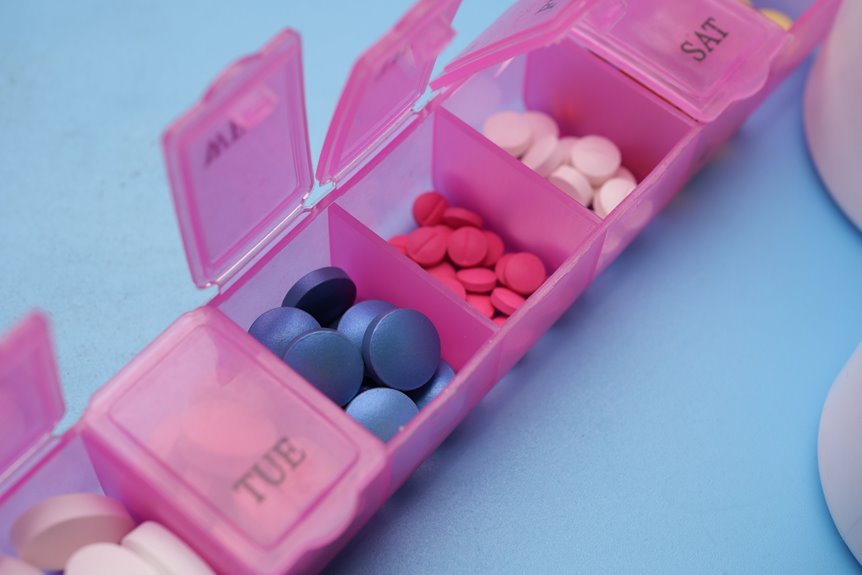
Pill organizers can support pill safety if used with travel containers that comply with flight restrictions; storage safety depends on tamper-evident packaging, dosage reminders, and careful travel planning, though organizers do not replace professional guidance for medication safety.
How Can I Cope With Missed Doses on Long Trips?
Missed doses on long trips require careful planning and dose timing adjustment, with medical guidance. He or she should not double up; instead, resume at the next scheduled time, monitor effects, and seek advice for future travel strategies.
Conclusion
In a curiously ordinary moment, a traveler discovers a forgotten bottle in a hotel drawer, its label mirroring a routine chart from home. Coincidence threads through practice: a familiar expiration date, a predictable cooler bag, a planned stop for a dose. The scene reinforces that disciplined storage, even amid chance encounters, sustains efficacy. Precision in labeling, temperature control, and timing remains the quiet constant guiding safe travel with meds.